
.png)
.png)
.png)
.png)
.png)
.png)
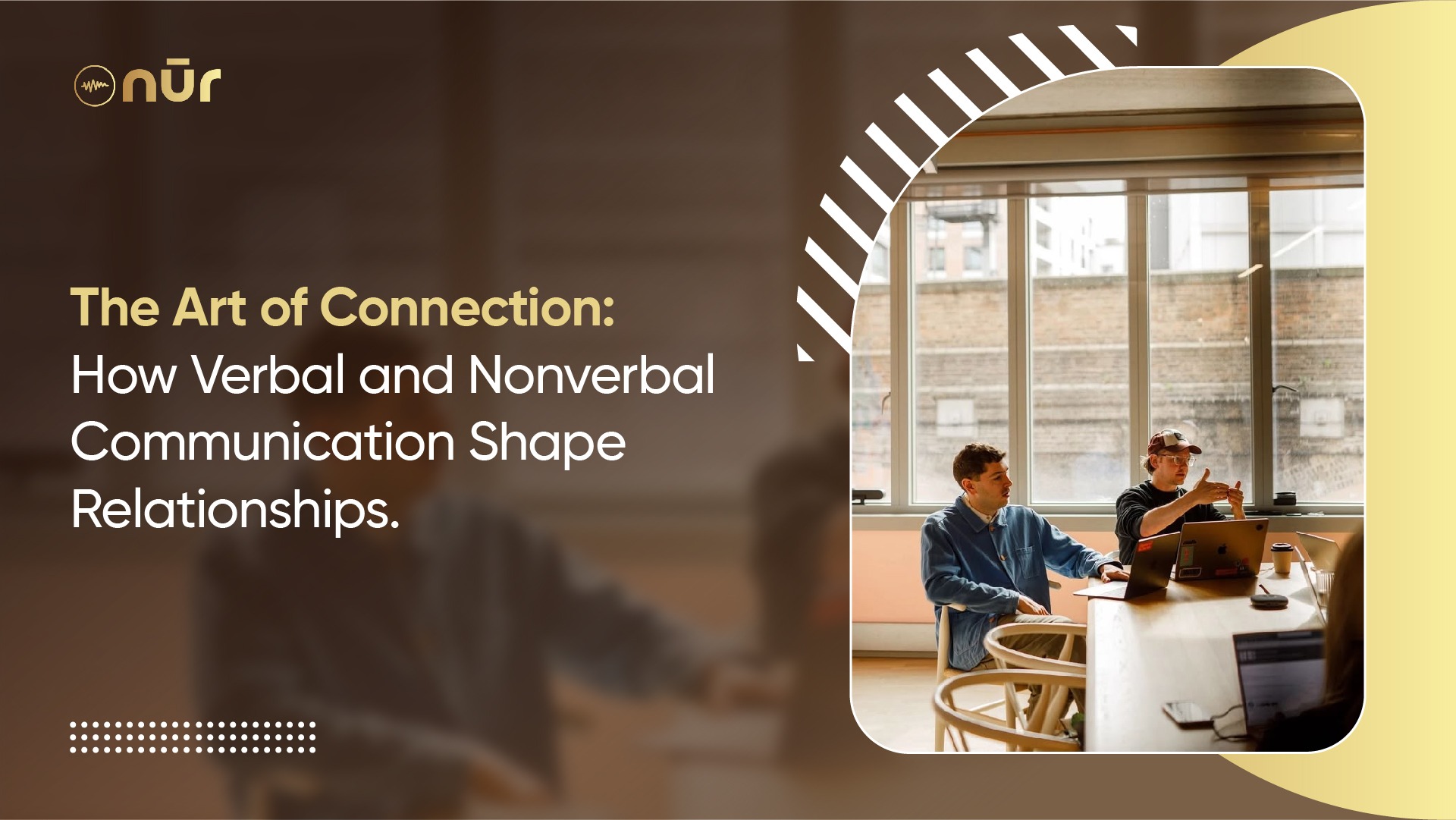
Every relationship in your life, professional or personal, is built through communication. However, most people only pay attention to the words they choose. They craft their message carefully. They pick the right phrase. They rehearse what they plan to say.
But when the conversation actually happens, something still feels off. The connection does not land the way they intended. The other person does not respond the way they hoped.
This happens because words are only half of the message. The other half is everything your body, voice, and energy communicate without a single syllable. Verbal and nonverbal communication work together constantly, and when they are out of sync, people feel it even if they cannot name it.
Understanding how both channels work and how to align them deliberately is one of the most valuable skills any professional can build. This blog breaks down exactly how that works and how tools like Nur AI help professionals measure and improve both sides of the equation.
What Verbal Communication Actually Covers
Most people assume verbal communication simply means speaking. However, it covers far more than the words you say out loud.
The Key Elements of Verbal Communication
Examples of verbal communication go well beyond vocabulary. They include:
- Pace: How fast or slow you deliver your words
- Tone: The emotional quality and warmth behind your message
- Rhythm: The natural flow and structure of your sentences
- Emphasis: Which words do you stress and why
- Clarity: How cleanly and precisely your ideas come across when spoken live
All of these elements shape how your message is received. Furthermore, they shape whether the listener trusts you, follows your thinking, or feels genuinely connected to what you are saying.
A clear, well-paced verbal delivery makes ideas feel credible and easy to absorb. A rushed, flat, or inconsistent delivery creates friction, even when the content itself is excellent. Verbal communication is not just about language. It is about the quality and intention behind every word you put into the air.
The Role of Verbal and Nonverbal Communication in Every Relationship
Relationships are built on communication patterns repeated over time. Every interaction you have with a colleague, client, partner, or team member adds to that pattern. Over time, those patterns create either trust and connection or distance and misunderstanding.
The relationship between verbal and nonverbal communication sits at the center of all of it.
What Happens When They Are Out of Sync
When your words say one thing and your body communicates another, people sense the mismatch immediately. Consider these common examples:
- A leader who says "I trust this team" while avoiding eye contact and crossing their arms
- A founder who delivers a confident pitch but speaks in a tight, rushed voice
- A manager who gives positive feedback in a flat, disengaged tone
In every case, the verbal message and the nonverbal signal contradict each other. As a result, the listener feels confused and instinctively defaults to trusting the nonverbal signal over the words.
Alignment between what you say and how you say it, verbally and physically, is what makes communication feel genuine. Without that alignment, even the best-prepared message falls short.
Understanding the Types of Nonverbal Communication
Nonverbal communication is not a single channel. It is a collection of signals that operate simultaneously throughout every interaction.
The Main Types You Need to Know
Understanding the types of nonverbal communication gives you a complete picture of how much is being communicated without words at any given moment:
- Facial expressions: The most immediate signal; they respond faster than conscious thought
- Posture and body orientation: Communicates how present and engaged you are
- Gestures: Add emphasis and energy to your words when used with intention
- Eye contact: signals confidence, attention, and respect
- Vocal tone: The quality, warmth, and steadiness of your voice
- Use of space: Communicates comfort, authority, and relationship dynamics
- Touch and proximity: Signal familiarity, trust, or professional distance
Each of these channels operates continuously. Together, they form the full nonverbal picture that every listener is reading, consciously or not.

Body Language Cues That Shape Professional Relationships
In professional settings, body language cues carry enormous weight. They influence whether a client trusts your recommendation, whether a team follows your lead, and whether a negotiation moves in your favor.
What Stress Does to Your Body Language
The challenge is that most professionals have very little awareness of the cues they are sending in high-pressure moments. Under stress, the body tends to:
- Collapse posture inward
- Break eye contact inconsistently
- Shrink or eliminate natural gestures
- Tighten the voice and reduce its natural range
- Speed up pacing without realizing it
All of these shifts happen automatically. Furthermore, they send signals of uncertainty that directly contradict the confident message the professional intends to deliver.
How to Build Body Language Awareness
Building awareness of your body language cues starts with two practical steps:
- Slow down deliberately. Pay conscious attention to how your body behaves during live conversations
- Use real-time feedback tools. Get objective data on your vocal signals so you see what your nonverbal communication is actually doing, not just what you intend
Visual Communication and Its Impact on Connection
Visual communication is the layer of nonverbal signaling that operates through appearance, environment, and visual presentation.
Why It Matters More Than Ever
In remote and hybrid work environments, visual communication has become especially important. When colleagues and clients cannot read your full body language in person, your visual presence on screen fills that gap.
Here is what visual communication covers in a professional virtual setting:
- Camera quality and positioning , A clear, eye-level setup signals professionalism and respect
- Background environment: A clean, uncluttered background keeps attention on you
- Lighting: Good lighting communicates effort and intention
- Eye contact with the camera: Recreates the feeling of direct engagement in virtual conversations
- Appearance and presentation: Sets the tone before you say a single word
Visual communication is not about aesthetics. It is about ensuring that every visual signal you send actively supports the relationship you are building.
Nonverbal Communication in the Workplace
Nonverbal communication in the workplace operates at every level of professional life , from how leaders carry themselves in difficult conversations to how new team members read the culture on their first day.
Where It Shows Up Most
The most effective workplace communicators align their nonverbal signals with their professional intentions consistently. Nonverbal communication shapes outcomes in these key professional moments:
- Job interviews: Hiring decisions are heavily influenced by body language and vocal confidence
- Team meetings: engagement, posture, and energy signal leadership presence or its absence
- Client presentations: Credibility is built or lost in the first 30 seconds of delivery
- Performance reviews: Tone and expression determine whether feedback is received or rejected
- Negotiations: Steady, controlled nonverbal signals convey authority and conviction
Moreover, effective workplace communicators actively track and measure their communication patterns over time, because consistent growth requires consistent feedback.

How to Improve Nonverbal Communication Skills Deliberately
Knowing that nonverbal communication matters is one thing. Building the practical skill to improve it is another.
A Step-by-Step Practice Framework
How to improve nonverbal communication skills starts with awareness, and awareness requires data, not just good intentions. Here is a clear framework to follow:
Step 1: Record yourself.
Record practice presentations or conversations. Watch the playback with the sound off first. Notice what your face, posture, and gestures communicate independently of your words.
Step 2: Isolate each channel.
Practice each nonverbal channel individually:
- Work on maintaining steady eye contact during responses
- Practice speaking with more intentional vocal variation
- Slow your pacing to give each point more weight
Step 3: Get objective feedback.
Seek feedback from someone who can observe your nonverbal signals without bias. Additionally, use tools that measure your vocal signals in real time so you get data , not just opinions.
Step 4: Practice under pressure
Simulate high-stakes scenarios and practice maintaining your nonverbal alignment when the stakes feel real. Over time, new habits replace old automatic patterns.
Soft Skills and Active Listening: The Human Layer of Communication
Soft skills in communication are the human qualities that make technical skill feel trustworthy and relatable. They include:
- Empathy and emotional awareness
- Patience and adaptability
- The ability to read a room accurately
- Openness and approachability under pressure
These qualities are expressed almost entirely through nonverbal and vocal signals, not through the content of what you say.
Why Active Listening Changes Everything
Active listening skills are one of the most powerful soft skills available to any communicator. Active listening means:
- Giving full, undivided attention to the speaker
- Tracking not just words, but tone, energy, and emotional signals
- Responding in a way that shows you truly absorbed what was said
- Asking questions that reflect genuine understanding
When someone feels genuinely heard, trust deepens fast. Conversely, when a listener is visibly distracted or responds without fully absorbing the message, connection breaks down, and it is difficult to rebuild.
The Importance of Aligning Both Communication Channels
The importance of verbal and nonverbal communication becomes clearest when you see what happens when they are misaligned.
What Misalignment Costs You Professionally
Mixed signals create confusion and erode trust faster than almost any other communication breakdown. Here is what misalignment looks like in practice:
- Saying you are confident while your voice sounds tight and rushed
- Claiming to be engaged while your posture signals distraction
- Delivering positive feedback in a flat, emotionless tone
- Presenting a strong idea while avoiding eye contact with decision-makers
People may not consciously identify the mismatch. However, they feel it , and they respond by pulling back, questioning credibility, or disengaging entirely.
How Nur AI Helps Close the Gap
Alignment between verbal and nonverbal signals requires self-awareness, consistent practice, and honest feedback over time. This is precisely where Nur AI gives professionals a real advantage.
By measuring your vocal signals—clarity, confidence, resonance, authenticity, and connection—in real time, Nur AI gives you the data to understand how your communication is actually landing across both channels, not just how you hope it is landing.
Verbal vs. Nonverbal Communication: Which One Matters More?
This is one of the most common questions in communication science, and the honest answer is neither.
Why It Is Always Both
Verbal vs. nonverbal communication is not a competition. It is a collaboration. The most effective communicators treat both channels with equal intention and equal investment:
Your words carry the content of your message. Your nonverbal signals carry the credibility and emotion behind it. When both are strong and aligned, your communication creates genuine connection. When one is weak or inconsistent, the other cannot fully compensate.
Conclusion
Every relationship, at work, in leadership, in business, and in life, is shaped by the quality of communication across both verbal and nonverbal channels. Verbal and nonverbal communication are not separate skills. They are two sides of the same signal. When they work together with intention and alignment, they build trust, create connection, and move relationships forward in meaningful ways.
The professionals who communicate most effectively are not the ones with the loudest voices or the most polished words. They are the ones who understand how every signal they send is being received and who invest consistently in getting better at sending the right ones.
Nur AI gives you real-time vocal intelligence, session-by-session tracking, and AI-powered insights, so every conversation becomes an opportunity to connect more clearly, lead more confidently, and grow as a communicator in ways that show up in your real-world professional outcomes.
Your voice is already sending signals. Make sure they say exactly what you mean.
Try Nur AI free at mynur.ai , and start seeing how your verbal and nonverbal communication lands every time you speak.
Frequently Asked Questions
1. What is the difference between verbal and nonverbal communication?
Verbal communication includes all spoken and written language, the words, tone, pacing, and structure of your message. Nonverbal communication includes everything else: facial expressions, body posture, gestures, eye contact, and vocal quality. Both channels operate simultaneously in every interaction, and both directly shape how your message is received and how your relationships develop over time.
2. Why is nonverbal communication so important in professional relationships?
Nonverbal signals communicate trust, confidence, and credibility faster than words can. In professional settings, your body language, vocal tone, and eye contact shape how clients, colleagues, and leaders perceive your competence and character, often before you finish your opening sentence. Misaligned nonverbal signals can undermine even the strongest verbal message in any professional context.
3. How can I improve my nonverbal communication skills at work?
Start by recording yourself during practice conversations and watching the playback with the sound off first. Notice your posture, facial expressions, and gestures independently of your words. Then listen specifically to your vocal tone and pacing. Seek objective feedback on your nonverbal signals consistently. Use real-time feedback tools like Nur AI to measure your vocal signals across sessions and track your improvement over time.
4. How does active listening improve communication and relationships?
Active listening means giving your full attention to the speaker, tracking both their words and the emotional signals behind them. When people feel genuinely heard, trust builds quickly and consistently. Active listening is expressed almost entirely through nonverbal signals, consistent eye contact, open posture, and responsive facial expressions, which makes it one of the most powerful relationship-building tools available to any professional at any level.
5. How does Nur AI help improve verbal and nonverbal communication?
Nur AI measures your vocal signals—clarity, confidence, resonance, authenticity, and connection—in real time during every session. It tracks your performance across conversations, provides AI-powered insights after each session, and builds a personal baseline so you can see measurable growth over time. By giving you objective data on how your voice is actually landing, Nur AI helps you align your verbal and nonverbal communication with the impression you genuinely intend to create.

.jpg)