.jpg)

.png)
.png)
.png)
.png)
.png)
.png)
You walk into the room. Your heart picks up speed. You open your mouth and something shifts. The words come out quieter than you planned. Faster than you intended. Less certain than you felt. This is not a confidence problem. It is a voice problem. And voice is something you can train.
Knowing how to speak confidently in public is one of the most valuable skills you can build in 2026 whether you are pitching to investors, presenting on a Zoom call, or walking into a job interview.
The good news?
Confidence in your voice is not a personality trait you are born with. It is a pattern you can develop through deliberate, focused practice.
This guide breaks down 5 proven speech practice drills used by communication coaches, backed by what modern voice science tells us about how we are actually perceived and how a tool like Nūr AI can accelerate the process.
Why Most People Struggle to Sound Confident
Most public speaking advice focuses on what you say. But research in behavioral communication consistently shows that how you say it matters more, sometimes accounting for up to 65% of how your message is received.
When people freeze up in front of an audience, the breakdown usually happens in one of three areas:
- Pacing: speaking too fast under pressure, rushing through ideas
- Pitch control: voice rising at the end of sentences, making statements sound like questions
- Energy drop: losing vocal energy mid-sentence, trailing off before the point lands
These are not signs of poor knowledge or weak personality. They are patterns. And patterns can be changed.
Understanding this is the first step in applying solid public speaking tips for beginners. You do not fix confidence by thinking differently. You fix it by practicing the physical mechanics of sound.
The Science Behind a Confident Voice
Voice science, specifically the study of prosody, which covers pitch, rhythm, timing, and energy, gives us a clear map of what a confident voice actually looks and sounds like.
A few key findings:
- Slower pacing signals authority. Studies in social perception research show that speakers who pause before key points are rated as more credible and composed.
- Downward intonation closes ideas. Ending statements with a falling tone rather than rising is consistently associated with certainty.
- Consistent energy signals engagement. Flat voices lose listeners. Voices with varied but controlled energy hold attention.
This is exactly what Nūr AI measures. The platform analyzes over 20 acoustic features in real time, including timing, tone, and energy patterns, and shows you how your voice is actually landing. Not general advice. A precise signal.
Knowing this science also gives context to the drills below. Each one targets a specific vocal pattern that directly shapes how confident you sound.
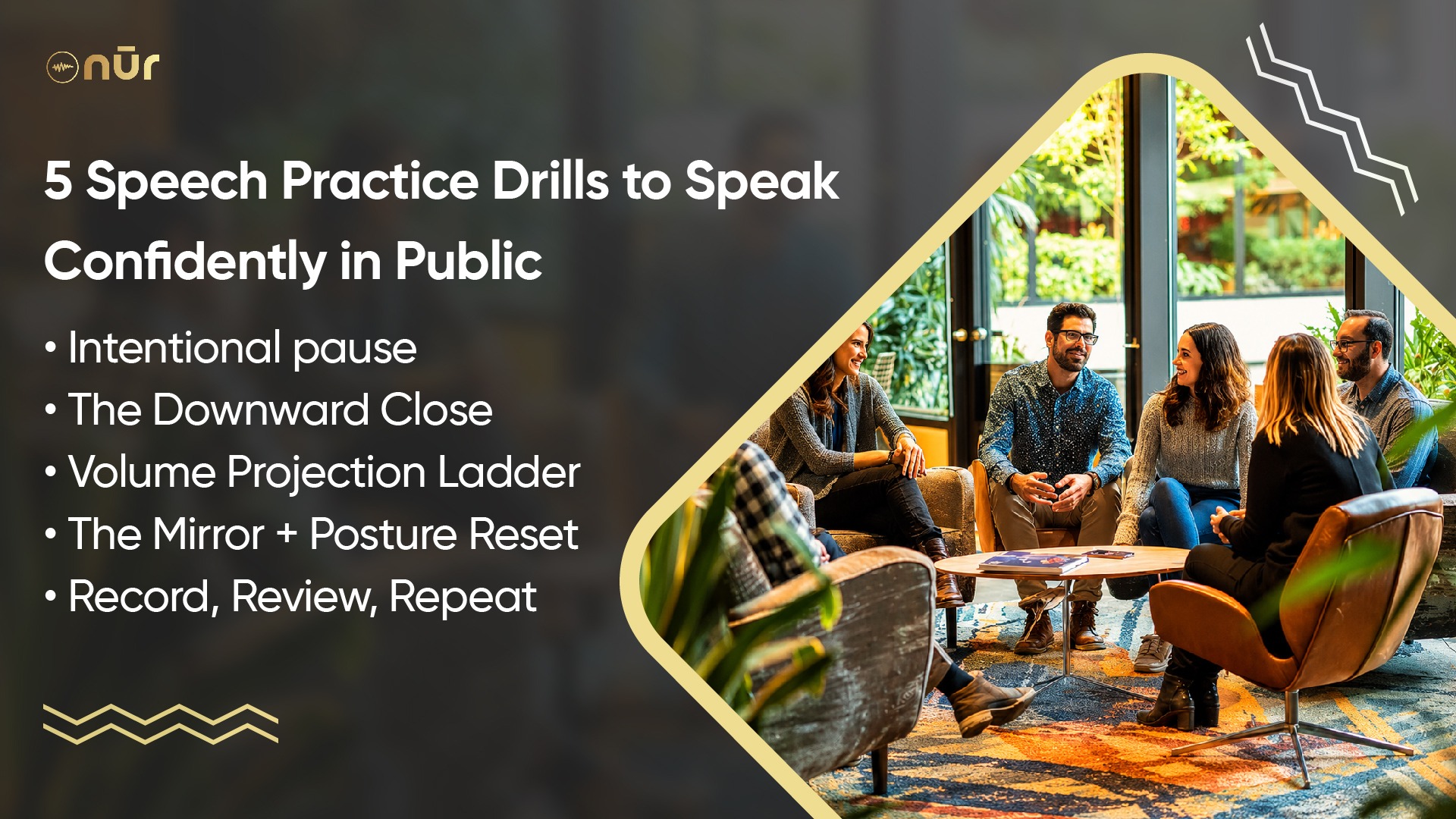
5 Speech Practice Drills to Speak Confidently in Public
These drills are not warm-up exercises. Each one trains a specific part of your vocal delivery. Build them into a 10- to 15-minute daily practice, and you will notice a difference within two weeks.
Drill 1: The Intentional Pause
This drill addresses the most common sign of nervousness: speaking too fast.
- How it works: Write out five sentences on any topic. Read each sentence, then stop completely for three full seconds before continuing. Record yourself. The pauses will feel unnatural at first. On playback, they will sound deliberate and authoritative.
- This is one of the most effective voice confidence exercises because it trains you to sit with silence, something most speakers are afraid of. Silence is not awkward to the audience. It gives them time to absorb what you just said.
- Practice target: 10 minutes daily for 7 days.
Drill 2: The Downward Close
Upward inflection at the end of sentences, sometimes called uptalk, undermines credibility. This drill corrects it directly.
- How it works: Read a paragraph aloud and consciously drop your pitch on the final word of every sentence. Place your hand on your chest and feel your voice settle downward. Over time, this becomes natural, your default closing pattern.
- This drill builds the tone control that separates people who sound confident in presentations from those who sound uncertain, even when they know their material.
- Practice target: 5 minutes per session, using prepared speaking material from your actual work.
Drill 3: Volume Projection Ladder
Learning how to project your voice when speaking is not about being loud. It is about controlled breath support and opening your resonance.
- How it works: Read the same paragraph at four volume levels: a whisper, conversational level, presentation level, and room-filling projection. Notice how your posture, breathing, and energy shift at each level. The goal is to practice moving between them fluidly.
- This drill is especially useful for hybrid and in-person presentations where the physical space changes. It also trains you to sustain energy throughout a full talk, not just the opening.
- Practice target: Move through the ladder twice per session. Focus on breath, not throat tension.
Drill 4: The Mirror + Posture Reset
Body language and voice in public speaking are inseparable. Your posture directly affects vocal quality. Collapsed shoulders compress the lungs, reducing breath support and making your voice quieter and flatter.
- How it works: Stand in front of a mirror. Roll your shoulders back. Lift your chin to a neutral position. Breathe from your diaphragm. Now speak a 60-second summary of a topic you know well. Watch your face and posture as you speak. Notice when you collapse and reset.
- Combining body awareness with vocal practice accelerates improvement faster than voice drills alone. The physical alignment is what gives your voice room to carry. Body language and voice in public speaking are two sides of the same signal.
- Practice target: One 60-second talk per day. Review posture checkpoints at the start of each.
Drill 5: Record, Review, Repeat
The most underused tool in public speaking practice is the recording. Most people avoid it because they dislike hearing themselves. That discomfort is exactly why it works.
- How it works: Record a two-minute talk on any topic. On playback, evaluate three things only: Did you pace too fast? Did your pitch rise on closing sentences? Did your energy drop in the second half? Take one note. Adjust. Record again.
- This drill mirrors what an AI public speaking coach does, except you are doing the analysis manually. For deeper insight, Nūr AI automates this process by measuring your acoustic patterns across sessions, so your improvement becomes visible over time, not just felt.
- Practice target: Three recordings per week. Track your notes across sessions to spot patterns.
How to Overcome Fear of Public Speaking Through Practice
Most advice on how to overcome fear of public speaking focuses on mindset: visualize success, breathe deeply, and reframe nerves as excitement. These strategies have their place. But they do not address the root cause.
Fear of public speaking is often fear of not sounding the way you intend. When you have practiced your vocal patterns, including pacing, pitch, projection, and posture, that specific fear shrinks. You know what you are going to do. Your body has rehearsed it.
The five drills above build that rehearsed confidence. Each session deposits a little more certainty into your delivery. After two weeks of deliberate practice, most people report that their anxiety is not gone, but it no longer controls their voice.
And that is the real goal: not the absence of nerves, but a voice that performs well regardless of them.
How Nūr AI Helps You Improve Faster
Self-practice gets you far. But most people plateau without feedback because they cannot objectively hear what their voice is actually doing.
Nūr AI fills that gap. It works across Zoom, Google Meet, Microsoft Teams, and Slack, the exact contexts where your voice needs to perform. It analyzes over 20 acoustic features in real time: pacing, tone, energy, timing, and pitch patterns. Not as a single snapshot, but as trends across conversations.
Think of it as an AI public speaking coach running quietly in the background during every meeting, every presentation, every call. One that tracks how your voice behaves over weeks, not just minutes.
This is what separates Nūr from generic coaching apps: the Nūr Signal. A single, composite measure of how you consistently come across, built from patterns, not single moments. The more you use it, the more precise and personal it becomes.
For anyone applying the drills above, Nūr provides the objective mirror that accelerates the loop: practice, measure, adjust, and improve. Learn more about AI-powered communication coaching and how it fits into a modern professional skillset.
To Sum Up
Knowing how to speak confidently in public is not about performing a version of yourself you are not. It is about removing the friction between what you know and how it sounds. The five drills in this guide target the specific patterns that undermine confident delivery, including pacing, pitch, projection, posture, and self-awareness. Practice them consistently, and the changes become audible within weeks.
But practice needs feedback to compound. That is where Nūr AI fits into the picture, not as a replacement for effort, but as the signal that makes effort measurable. Your voice already communicates. The question is whether it communicates what you intend. Start with the drills. Let the data guide what comes next.
Ready to Speak with Real Confidence?
Nūr AI analyzes your voice in real time, including pacing, tone, energy, and timing, so you can stop guessing and start improving. Be among the first to experience AI-powered voice coaching built on speech science.
FAQs: Speaking Confidently in Public
1. How long does it take to improve public speaking confidence?
Most people notice measurable changes within 2 to 3 weeks of consistent daily practice. The key is deliberate repetition, not just talking more but practicing specific patterns like pacing and pitch control. Using Nūr AI to track your voice over time speeds up this process significantly.
2. What are the best public speaking tips for beginners starting from scratch?
Start with breath control and pacing. These two elements underpin everything else. Record yourself speaking for 60 to 90 seconds on a familiar topic, then evaluate your pace and pitch. Do this three times a week before adding more complex techniques. The drills in this guide are ordered for beginners. Start with Drill 1.
3. Does body language really affect how my voice sounds?
Yes, directly. Collapsed posture compresses your lungs and limits breath support, making your voice softer and flatter. Open, aligned posture gives your voice room to carry. Body language and voice in public speaking are physically connected. Improving one improves the other. Research on posture and vocal performance consistently supports this link.
4. How do I stop my voice from shaking when I am nervous?
Voice shaking under stress is usually caused by shallow, fast breathing and muscle tension. The Intentional Pause drill (Drill 1) and diaphragmatic breathing both help significantly. Over time, deliberate voice practice trains your body to stay regulated even when your mind is anxious.
5. Can an AI really help me with public speaking?
Yes, specifically for measurement and feedback. An AI public speaking coach like Nūr AI can analyze the acoustic features of your voice that are hard to hear yourself, including pacing trends, pitch patterns, and energy across a full conversation. It does not replace human coaching or practice, but it gives you objective data that accelerates improvement in ways self-review alone cannot.



.jpg)