
.png)
.png)
.png)
.png)
.png)
.png)
Have you ever talked to Siri, Alexa, or Google Assistant and wondered how they understand you so well? Or maybe you have heard about companies using AI to detect emotions in customer calls. Both of these involve voice technology, but they are not the same thing.
In 2026, AI in voice recognition vs. voice analysis has become one of the most talked-about topics in tech, business, and healthcare. Yet most people, including many business owners, confuse the two or do not know which one they actually need.
This guide breaks it all down simply. You will learn what each technology does, how they differ, and which one is the right fit for your goals, whether you are a startup founder, a healthcare professional, or a coach looking to leverage cutting-edge technologies like Nūr AI.
What Is AI Voice Recognition Technology?
AI voice recognition, also called "AI speech recognition technology" or "Automatic Speech Recognition (ASR)," focuses on understanding WHAT is being said. It converts spoken words into text or commands that a machine can act on.
Think of it as the ears of a machine. It listens and transcribes.
Common Uses of Voice Recognition AI
- Speech-to-text AI for transcription and dictation
- Voice biometrics AI for speaker identification and authentication
- Virtual assistants like Siri, Alexa, and Google Assistant
- Real-time captioning for accessibility and meetings
- Voice commands in smart home devices and automotive systems
According to Grand View Research, the global speech and voice recognition market was valued at over $12 billion in 2024 and is projected to grow at a CAGR of 14.6% through 2030. That tells you this is not a trend; it is a transformation.
What Is AI Voice Analysis Software?
AI voice analysis software goes a layer deeper. It does not just capture WHAT you say; it studies HOW you say it. This includes your tone, pitch, rhythm, pace, and even micro-tremors in your voice that reveal emotional states.
This is where voice sentiment analysis, emotion detection from voice, and AI vocal biomarkers come into play. These tools analyze acoustic signals to extract meaningful insights about a speaker's emotional and physical state. Platforms like Nūr AI are built precisely on this science, capturing pacing, pitch, timing, and energy in real time to show you how your communication actually lands.
Common Uses of Voice Analysis AI
- Voice tone and pitch analysis in customer service centers
- Emotion detection from voice in mental health apps
- AI vocal biomarkers for detecting diseases like Parkinson's or depression
- Fraud detection in banking and insurance calls
- Performance coaching and communication skills training
- Market research and consumer sentiment studies
A 2025 report by MarketsandMarkets estimated the voice analytics market will reach $3.9 billion by 2026, driven largely by demand in healthcare and financial services.
AI in Voice Recognition vs Voice Analysis: Key Differences
Understanding the voice recognition vs. voice analysis difference is critical before investing in any AI voice processing technology. Here is a side-by-side comparison:
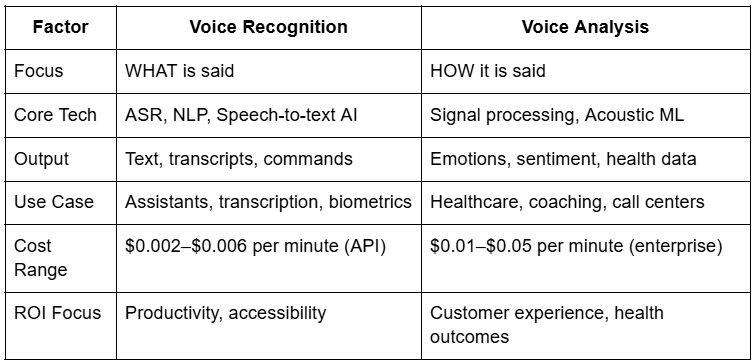
Tools like Nūr Signal sit firmly in the voice analysis column, measuring the real acoustic signals behind every conversation rather than just transcribing words.
Speech Analytics vs Voice Analytics: Is There a Difference?
Yes, and it is worth clarifying. Speech analytics vs. voice analytics is another common confusion point. Speech analytics focuses on analyzing the content of spoken language at scale; think keyword detection, topic flagging, and compliance monitoring. Voice analytics is broader and includes the acoustic properties of speech, like emotion and tone.
In 2026, many enterprise platforms like Observe. AI, CallMiner, and Balto combine both capabilities into unified solutions, but pricing and use cases differ significantly. For individuals and teams focused on communication growth, Nūr's AI-powered experience offers a more personalized approach to voice analytics.
When Is Each Technology the Better Choice?
Choose Voice Recognition When You Need To:
- Convert spoken meetings or calls into searchable text
- Build voice-activated commands into apps or devices
- Verify a speaker's identity through voice biometrics AI
- Improve accessibility for employees or customers
- Automate data entry using dictation software
Choose Voice Analysis When You Need To:
- Understand customer emotions during sales or support calls
- Detect signs of stress, burnout, or mental health changes
- Improve your team's communication and coaching performance
- Monitor brand sentiment through call center data
- Explore AI vocal biomarkers for early health screening
If you fall into that second category, exploring Nūr's membership options is a logical next step.
Real-World ROI: Is This Investment Worth It in 2026?
Both technologies offer measurable returns, but the ROI looks different depending on your industry.
- Contact centers using voice analytics see up to 20–35% improvement in customer satisfaction scores (CSAT) within 6 months of deployment.
- Businesses using ASR and speech-to-text AI reduce manual transcription costs by an average of 60–80%.
- Healthcare providers using AI vocal biomarkers for early detection report faster diagnoses and up to 30% reduction in unnecessary tests.
- Sales teams using emotion detection from voice close deals at higher rates; some studies show a 15–25% lift in conversion rates.
The key takeaway? Both technologies pay for themselves, but only when deployed with a clear strategy and proper training. Platforms like Nūr remove the guesswork by giving you clear, science-backed signals without requiring a technical background.
Expert Recommendation: Which Should You Invest In?
As an AI and technology coach with years of experience helping individuals and businesses adopt smart tech tools, we recommend starting with voice recognition if you are new to AI voice technology. It has lower costs, broader use cases, and a faster learning curve.
Once your team is comfortable with AI voice processing technology basics, layer in voice analysis tools, especially if you are in coaching, sales, healthcare, or customer experience roles. The emotional and behavioral insights from voice tone and pitch analysis can be genuinely transformative.
See how Nūr captures those signals in action.
For 2026, the smartest move is not choosing one over the other; it is building a roadmap that integrates both over time.
To Sum Up
AI in voice recognition vs. voice analysis represents two powerful but distinct branches of AI voice technology. Here is the quick recap:
- Voice recognition = understanding WHAT is said (transcription, commands, identity)
- Voice analysis = understanding HOW it is said (emotion, tone, health signals)
- Speech analytics vs voice analytics: speech = content at scale; voice = acoustic depth
- Both technologies deliver strong ROI when matched to the right use case
- Starting with ASR and building toward full voice analytics
Frequently Asked Questions
Q1. What is the main difference between voice recognition and voice analysis?
Voice recognition identifies WHAT is being said by converting speech to text or identifying the speaker. Voice analysis studies HOW something is said ; including tone, pitch, emotion, and acoustic patterns. They serve different purposes and use different AI models. Nūr is purpose-built for the voice analysis side of this equation.
Q2. Is speech-to-text AI the same as voice recognition?
Speech-to-text AI is a subset of voice recognition. Automatic Speech Recognition (ASR) is the most common form of speech-to-text technology. Voice recognition also includes speaker identification and voice biometrics, which go beyond simple transcription.
Q3. How accurate is emotion detection from voice in 2026?
Modern emotion detection from voice systems has reached accuracy rates of 85–92% under controlled conditions, according to recent industry benchmarks. Real-world accuracy varies based on audio quality, language, and the specific emotions being detected. Anger and high-arousal emotions are typically detected most accurately. Platforms like Nūr Signal apply this science to real-time communication coaching.
Q4. What are AI vocal biomarkers used for?
AI vocal biomarkers are acoustic features in your voice that can signal physical or mental health conditions. In 2026, researchers and healthcare providers are using them to screen for conditions like Parkinson's disease, depression, anxiety, and even early-stage respiratory illness—all from a short voice recording.
Q5. Can small businesses afford AI voice analysis software?
Absolutely. In 2026, many AI voice analysis software platforms offer tiered pricing starting as low as $49–$99 per month for small teams. API-based voice recognition tools like Google Cloud Speech, Amazon Transcribe, and Azure are even more affordable at pay-per-use rates. Nūr's membership plans are also designed to fit teams of different sizes. The key is matching the tool to your actual use case ; not buying enterprise software when a lightweight solution will do.
Ready to Navigate AI Voice Technology With Confidence?
Understanding AI in voice recognition vs. voice analysis is just the beginning. The real challenge is knowing how to apply these tools to your business, coaching practice, or career without wasting time or money on the wrong solutions.
That is exactly what Nur AI helps you do. As a leading AI and technology app, Nur AI works with professionals, business owners, and teams who want to harness the power of AI voice tools without the overwhelm. From personalized strategy sessions to hands-on training, Nur AI gives you a clear, confident roadmap to using AI the smart way in 2026 and beyond.
And if you are ready to experience AI voice analysis firsthand, join Nūr's early access program and see exactly how your voice signals land in real conversations. You can also learn more about the Nūr experience or explore the Ambassador Program if you want to share this technology with your community.
Visit NurAI.com to learn more and schedule your session.


.jpg)